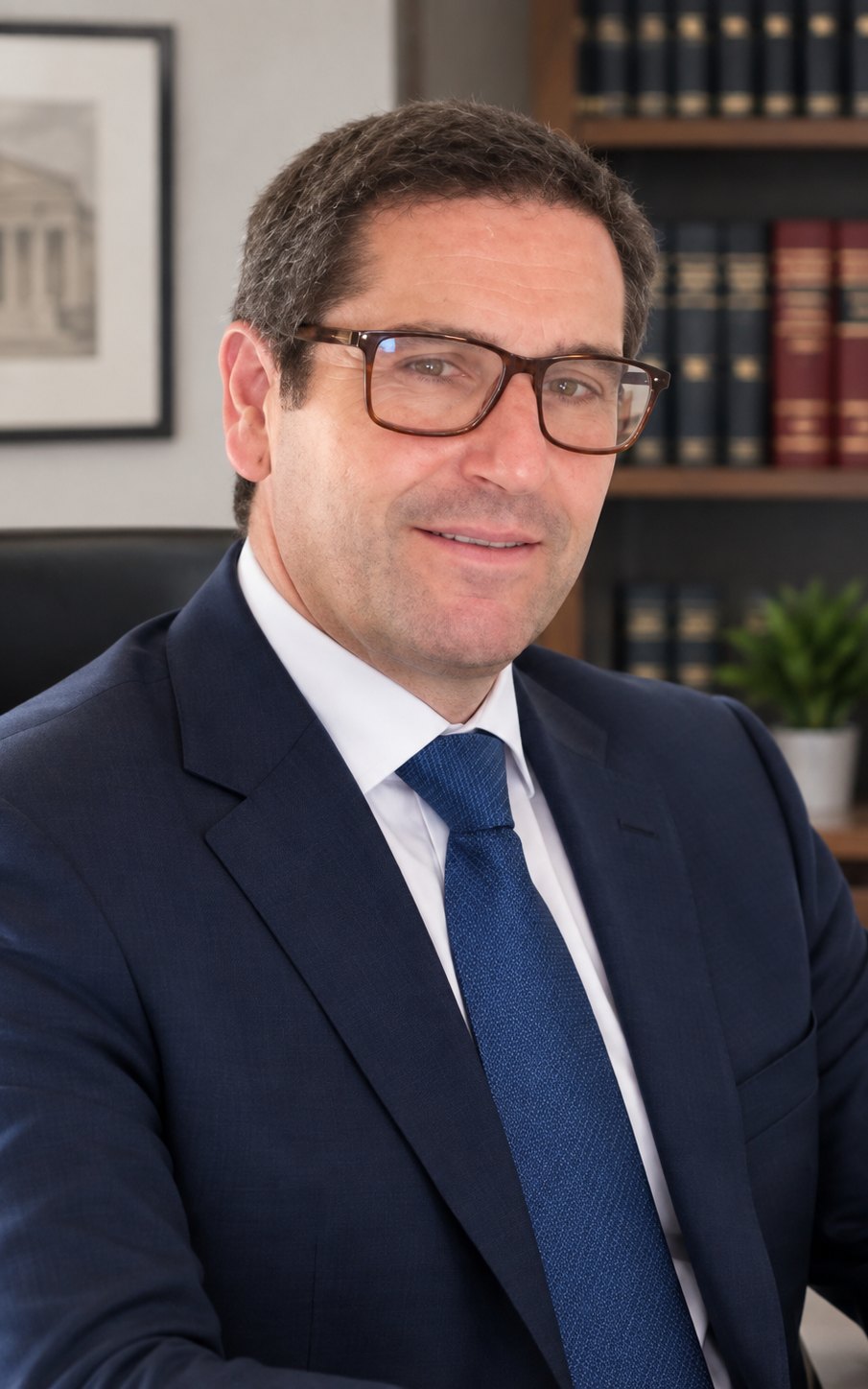
Javier Gómez Sanz has spent more than thirty years working on a single question: how far Member States may restrict the movement of food by invoking the protection of health or of consumers. It is the question that today decides whether a product can be sold in Europe, and he has approached it from every side on which it arises.
The first was the university. He trained in European law at the Universitat Autònoma de Barcelona, where he obtained an LL.M. in European Studies and completed the doctoral courses. At the Europa-Institut in Saarbrücken he studied how the same tension between trade and health is resolved in the WTO, in the agreements on sanitary and phytosanitary measures and on technical barriers to trade, and in the standards of the Codex Alimentarius. For almost two decades he taught Public International Law and European Community Law at Universitat Pompeu Fabra; he later directed the Chair of Food Regulation at the Universidad Católica San Antonio de Murcia and its postgraduate programmes, and taught on the health and regulation courses of Mexico's National Institute of Public Health.
Administration and research came next. At IRTA, the agrifood research institute of the Government of Catalonia, he took part in drafting technical regulations for the agrifood sector on the coexistence of genetically modified crops, the confined release of GMOs and the classification of pig carcasses, and saw from the inside how food is researched. At Parc Tecnològic del Camp he managed research centres and projects on functional foods, new ingredients and botanical extracts, following them from the field to the finished product. For companies in the sector he promoted two research consortia under the Spanish CENIT programme, MET-DEV-FUN and HENUFOOD. As head of Quantum Experimental, a clinical research and registration company, he learned how a clinical study is designed and how a food supplement or a medicinal product is registered.
His way of working comes from that period. Faced with a health claim, he does not stop at Regulation (EU) No 432/2012: he examines the studies behind it, distinguishes whether the effect has been shown in humans or only in experimental models, and considers the mechanism by which the substance acts. On that basis he decides what can be said about the product, in what words and with what support if an authority or a competitor challenges it. The same concern for evidence led him to the scientific committee of the INCOMES project, on the substantiation of claims relating to immune function, cognitive function and metabolic syndrome.
The last perspective is that of the company. For more than a decade he has advised national and multinational food and pharmaceutical groups, as well as industry associations. His work has covered the additives, ingredients and labelling required by each target market, the legislative proposals that affect them, dealings with the Spanish Agency for Food Safety and Nutrition (AESAN) and regional authorities, mutual recognition procedures and cases before Autocontrol, the Spanish advertising self-regulation body.
At Food Tech Legal he brings these four perspectives together in a regulatory practice in EU food law.
Working languages: Spanish, English, French and German.